


I independently & honestly review all of my travel recommendations. If you click on links I provide, I may receive compensation
One of my favorite things to do when visiting a new place is to check out its local history museum. Whether operated by cities or regions, these museums can give you a detailed background of the area and its people’s history. I visited the Svaneti Museum of History & Ethnography in Mestia, Georgia, and found it to be one of the best local museums I have visited.
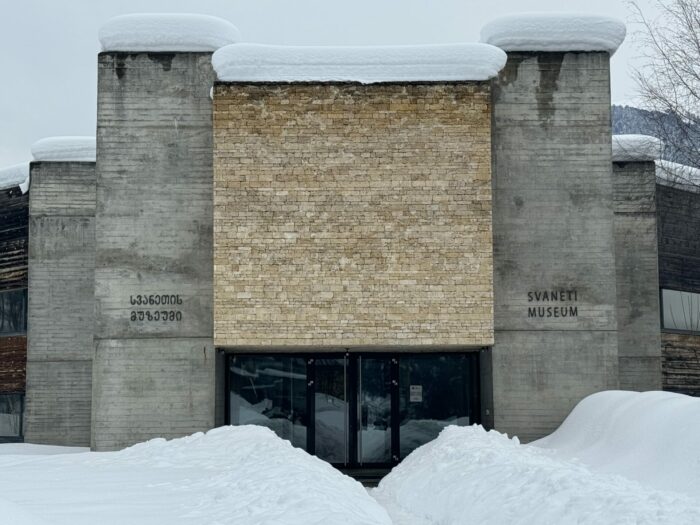
The award-winning Svaneti Museum of History & Ethnography is part of the Georgian National Museum. In some places, local history museums must make do with a few small exhibits inside some other building, but the Svaneti Museum of History & Ethnography is located in a beautiful dedicated museum just outside of the center of Mestia.

There are beautiful views of the town from its windows.

I love it when a museum goes beyond displaying exhibits in a basic manner. The Svaneti Museum of History & Ethnography presents everything well inside its modern space (which opened in 2013), with great lighting and signs in Georgian and English.
We had an informative guided tour from our guide, Rusudan, but the signs also provided detailed information.
Our visit started at the entrance, where signs detailed the museum’s history. The museum first opened in 1936 and became part of the Georgian National Museum in 2004.
As is customary at museums, we headed through the museum’s rooms chronologically, starting with the Stone Age. Although the region was settled then, it was only for temporary housing by hunters.
Later, in the early Bronze Age, around 2000-3000 BC, Svaneti supplied other areas in the region with minerals such as gold. This gold was found in the rivers that run through the valleys. The Georgian government would actually like to bring gold mining back to the region, but the local population is against it.
The next sections of the museum covered the Georgian cult of the sun and Colchian bronze culture. Artifacts included axes, spears, jewelry, and other objects.
During the Classical Period, the inhabitants created stones with holes. These stones are unique to Svaneti & are related to stones of sin.

Our tour continued with the Middle Ages. The exhibit included items found in burial grounds.

Another room included an exhibition of coins throughout history, including Alexander the Great golden coins. The oldest coins are from the 5th century BC.

One of the most impressive rooms of the Svaneti Museum of History & Ethnography is filled with beautiful Svan icons.

Highlights included the two-sided icon of the archangel Michael, Angel Gabriel’s icon, a triptych, and several icons of St. George. Although it’s not likely that Georgia is named for St. George, but rather from the Persian word for “wolf,” he is a popular figure in the country.

This was my favorite part of the museum.

Even as someone who is not religious, I could see the beauty and devotion in the artworks.
Another room had a collection of crosses, including metal plate crosses & liturgical fans.

The rarest item in this room is a Venetian cross, of which only three similar exist: one in New York City and one in Italy.

There were also large displays of important historical objects, including manuscripts, an 11th-century pulpit, and a ritual cauldron.

Another room focused on weapons & jewelry.


The final sections of the permanent collection included items relating to everyday life in the most recent centuries, such as furniture & local clothing.

Finally, there was a special exhibition about Vitorrio Sella, an Italian photographer who photographed the area. The photos of local people and landscapes, including the famous Svan towers, were similar to those on the walls of my excellent hotel, the Gistola Hotel.

The Svaneti Museum of History & Ethnography provides an excellent overview of the region’s rich history. While most visitors to Mestia are there for outdoor activities such as hiking or skiing, I highly recommend checking out the museum, too.
Here are some other great Tbilisi tours & activities.
Do you have upcoming travel that you need to book? Use my travel resources page to make your bookings! There's no cost to you, and you'll be supporting my site. Thanks!
For Georgian wine experiences, I recommend taking a day trip to Kakheti from Tbilisi. Also, you can visit the many wine bars in Tbilisi.
If wine isn’t your thing, Tbilisi also has excellent cocktail bars & craft beer bars & breweries. Be sure to try the local spirit known as chacha!
Need a place to stay? Check out these Tbilisi hotel options. I enjoyed my stay at the Moxy Tbilisi, and the Radisson Blu Iveria Hotel is another excellent option.
Note: My visit to Mestia was part of a Traverse press trip sponsored by Visit Georgia. All opinions are 100% my own.
