


I independently & honestly review all of my travel recommendations. If you click on links I provide, I may receive compensation
On my first visit to Istanbul, I stayed at the Bankerhan Hotel, a nice hotel in Galata that has excellent value. The hotel is in a great location on a quiet street. One drawback is that it’s pretty low on the hill upon which Galata Tower rests, with many other Istanbul landmarks in Beyoğlu further beyond that.
I spent my first couple of days trudging up this hill to meet with friends staying off the pedestrianized İstiklal. It’s a pretty walk through winding cobblestone streets, so aside from the uphill aspect, it’s a nice walk. But I thankfully learned there was a much better way to get up the hill, one that also appeals to my transit nerd sensibilities.
Istanbul is home to the world’s second-oldest underground public transportation line (after the London Underground). This line is the Istanbul Tünel, a funicular railway that runs up and down the hill between Karaköy and Beyoğlu. While exercise is nice, a funicular is better!
One way to get a nice introduction to Istanbul is to take a tour. Check out these excellent tour options & book now!
Istanbul Tünel History and Construction
In 1867, Eugène-Henri Gavand, an engineer from France, visited Istanbul. Like me, he realized getting up the hill from Galata to Pera (the names of Karaköy and Beyoğlu at the time) was a pain for both locals and visitors.
Unlike me, he did something about it. He returned home to France to work on plans for an underground funicular railway. These plans were approved by Sultan Abdülaziz in 1869.
After some funding and management delays, construction on the Tünel in Istanbul started in 1871. Further conflicts with landowners and other issues kept delaying work, but the Beyoğlu Karaköy Tunnel finally opened for passengers on January 17th, 1875.
The original trains were two-car steam-powered wooden trains that could carry humans, as well as animals and freight, with one car used for each. Men and women each had their own sections in the human car.
The system underwent its first modernization refurbishment between 1968 and 1971. Wooden cars were replaced with steel, and the Tünel funicular was electrified.
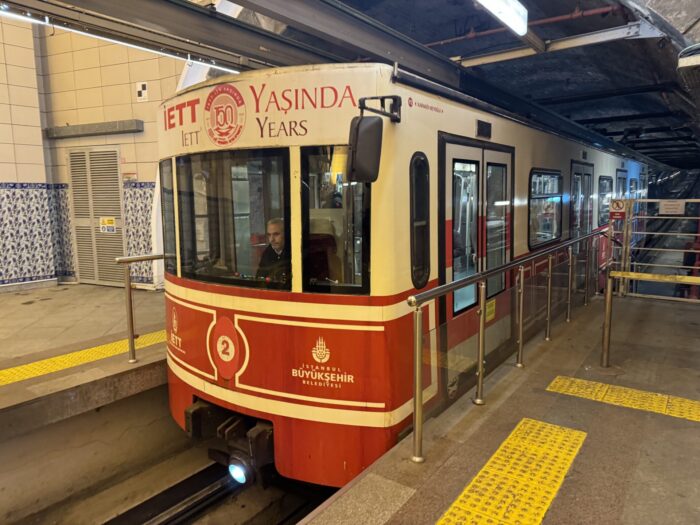
Today, the funicular railway uses modern cars that entered service in 2007. Each car holds 170 people, so there is plenty of space. Around 12,000 people ride through the Tunnel daily.
Riding the Istanbul Tünel
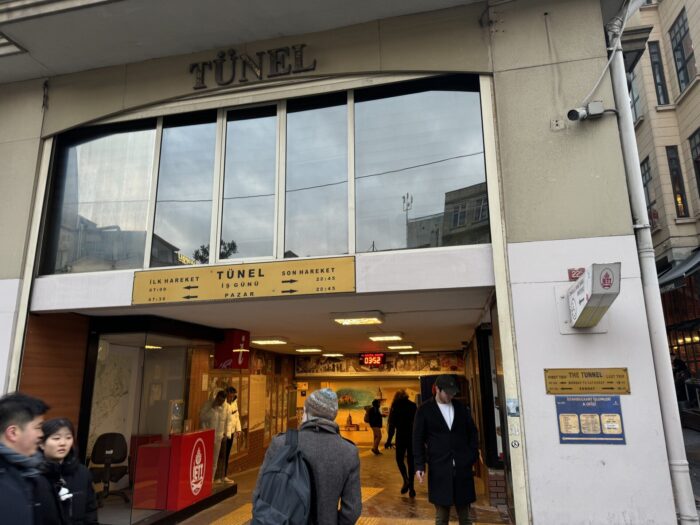
Tünel is integrated with the Istanbulkart system, which makes it easy to tap and pay at the fare gate. If you’ll be in Istanbul for any length of time, be sure to get an Istanbulkart card (official website).
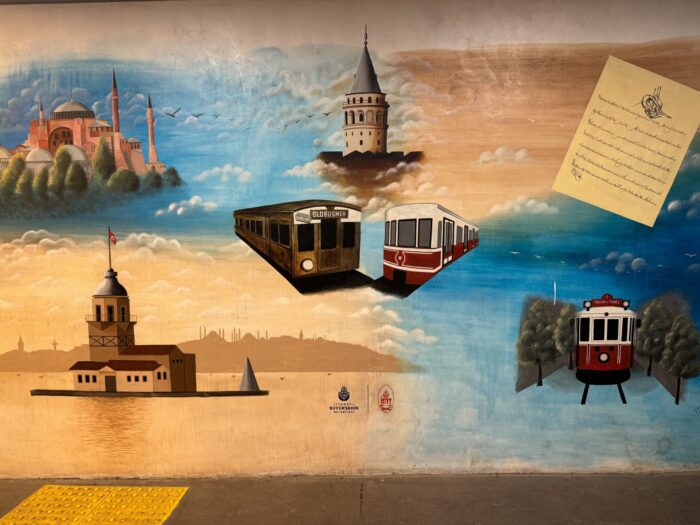
The Karaköy station has a mural and other artwork depicting the city.
There are also information panels telling the history of the Tünel funicular.

There’s even a 3D model of the neighborhood that shows what the tunnel passes under.

If you’re not in a hurry, you can stay in the station until the next train arrives. They depart roughly every 3.5 to 6 minutes, so the wait is not long. Sometimes it’s also easier to wait rather than pack yourself into a subway car at the last second.
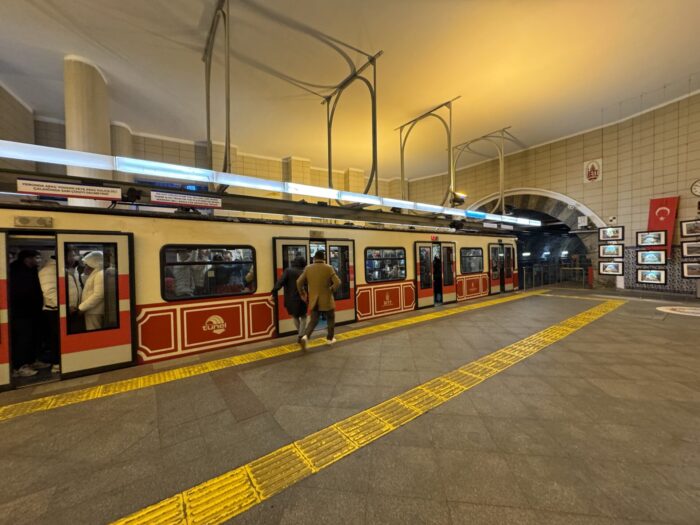
Once you’re moving, the ride takes about 90 seconds to traverse the tunnel’s 573 metres (1,880 feet) underneath Istanbul. I enjoy standing at the front to get the best views of the journey.
It’s a smooth ride, and you’ll pass the train going the other direction at the midway point.

When you arrive at the Beyoğlu funicular station, you have also climbed 61.55 meters (201.9 feet) without any effort.
Congrats! You’ve saved that energy for more important things like exploring the rest of the city or eating the wonderful Turkish food.

Tip: Head to the nearby Hasan Fehmi Ozsut (map), which specializes in one of my favorite Turkish dishes, bal kaymak (clotted buffalo cream and honey).
Alternatively, you can continue to ride more of Istanbul’s historic public transportation network by taking the red tram down İstiklal Avenue to Taksim Square.

If you’re interested in getting another glimpse of Istanbul’s history, I recommend the Istanbul Railway Museum and the Museum of Innocence.
Here are some great Istanbul tours.
If you’re looking for a place to stay, check out these Istanbul hotels.
Do you have upcoming travel that you need to book? Use my travel resources page to make your bookings! There's no cost to you, and you'll be supporting my site. Thanks!
